
Back to blog

Washington DOH introduces real-time pollen monitoring to combat spring allergies

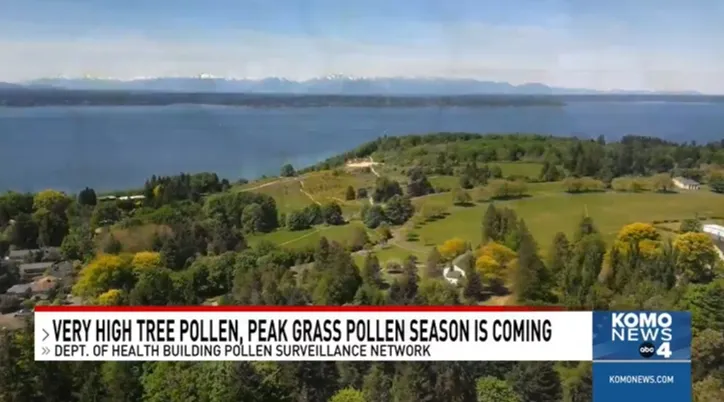
Spring showers bring May flowers, but they also bring a longer pollen season, according to the Washington Department of Health.

Washington DOH introduces real-time pollen monitoring to combat spring allergies

Spring showers bring May flowers, but they also bring a longer pollen season, according to the Washington Department of Health.

The department reports that pollen season in Washington starts almost three weeks earlier and lasts about a month longer than it did 30 years ago.

Tree pollen has been very high during the beginning of May. Grass pollen is expected to peak in mid-May. According to the DOH, one in four Washingtonians suffer from seasonal allergies.

To help those suffering from seasonal allergies, the DOH is building a pollen surveillance system that provides real-time pollen detection information.

“Our pollen monitors are continually monitoring pollen levels so we can see how much they vary during a day,” said Rad Cunningham, a senior epidemiologist and climate section manager at the DOH.

Cunningham explained the data collected from 10 pollen surveillance sites across Washington state is available on the Pollen Wise app.

“All of our monitors push data to the Pollen Wise app, and you can go look at what the pollen levels are, and you can even look at the specific pollens that you’re allergic to,” Cunningham said.

The DOH attributes the earlier and longer pollen season to climate impacts such as warmer temperatures, changes in rainfall patterns, and increased carbon dioxide in the air.

“Tree pollen starts earlier, and now we’re transitioning into a grass pollen season,” said Cunningham. “A lot of people with grass allergies are really feeling it right now, and the warmer temperatures certainly can contribute to that, as can climate change.”

More from Pollen Sense

A clearer, more helpful Pollen Wise home screen

We’ve been spending a lot of time reviewing feedback, reading survey responses, and looking closely at how people are using Pollen Wise. One common thread amongst the feedback and survey responses stuck out: people want the app to feel easier to understand at a glance, and more helpful in answering the question, “What should I care about right now?” That thinking shaped this latest update. This is a major refresh to the Pollen Wise home screen, and while we know there is still more to improve, this update is an important step. We’re continuing to build, refine, and learn, and your feedback is a big part of what helps us decide where to go next.

Incoming: Branches, Revisions, and Layers

Update: The data cutoff for legacy metrics data was changed from March 11 to March 23, 2026 6PM UTC. Data before that date will continue to be available for the forseeable future, however data after March 23, 2026 6PM UTC will no longer be present either in the legacy portal data viewer or via v1 APIs. Please use the V2 APIs and the Branch/Revision-powered data viewer in the portal for live incoming data

LLMs vs CNNs: Why Physical AI Starts With Data Infrastructure

When we say “AI” at Pollen Sense, most people assume we mean LLMs. We don’t. When people hear that Pollen Sense is building AI data infrastructure, the default assumption is usually large language models, chatbots, text generation, or conversational AI. That’s understandable given the moment we’re in. But it’s not what we mean when we say AI. At Pollen Sense, AI data infrastructure means Physical AI, machine learning systems that directly observe the real world, classify physical signals in real time, and convert them into structured, trustworthy data that other systems can reason on.

Take a Deep Breath

Real-time particulate intelligence for public health, research, and daily life.

Whether you need a sensor network, licensing, or a better allergy experience, the same Pollen Sense infrastructure powers it.