
We’ve been spending a lot of time reviewing feedback, reading survey responses, and looking closely at how people are using Pollen Wise.
One common thread amongst the feedback and survey responses stuck out: people want the app to feel easier to understand at a glance, and more helpful in answering the question, “What should I care about right now?”
That thinking shaped this latest update.
This is a major refresh to the Pollen Wise home screen, and while we know there is still more to improve, this update is an important step.
We’re continuing to build, refine, and learn, and your feedback is a big part of what helps us decide where to go next.
What’s new in this update
A better experience for free users
One common complaint was the number of upsell prompts throughout the app. To address this, upsell prompts have been significantly reduced on the home screen, only prompting for upgrades for the additional breakdown of allergens and the heat map.
- the main home screen experience shows highs and lows for all users, regardless of subscription status
- Heat maps remain a Pollen Wise Elite feature, as they always have been
- The overall experience should feel more straightforward and less cluttered
We also expanded access to speciation for free users. Previously, only the average was available. We’ve expanded this to include the high and low for today as well (subscribers unlock access to the rest of the forecast as well as historical data)
Daily highs and lows separate Pollen Wise from any other allergy app, because only Pollen Wise is backed by a network of automated monitoring sensors that continuously sample airborne particulates!
A home screen that’s easier to understand
Another big change is how the data is presented.
We heard that the old view could feel too dense and too hard to interpret quickly. Many users were not asking for more numbers on the screen, they were asking for clearer guidance and a better sense of what actually matters.
So we redesigned the home screen to make the information:
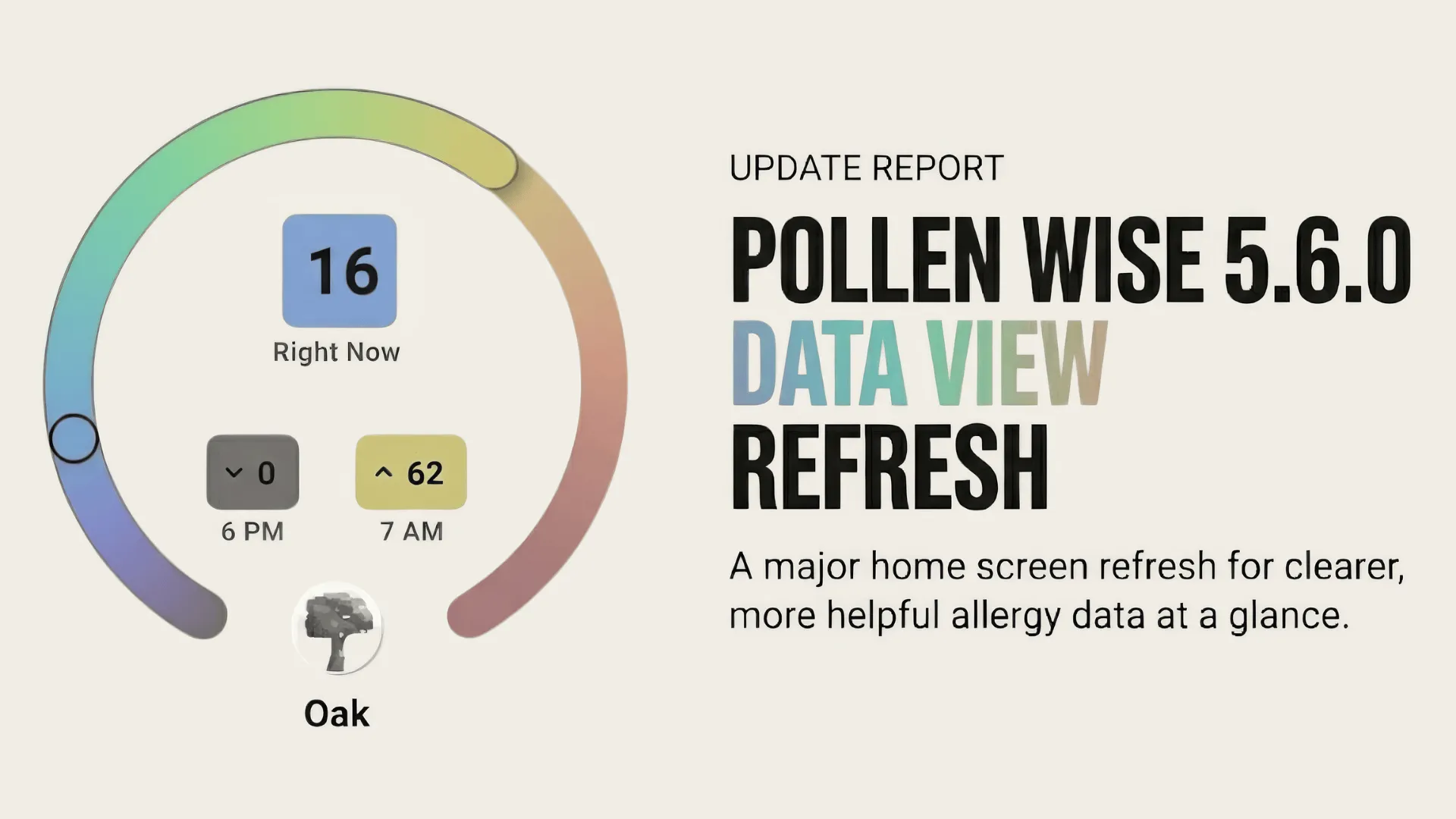
- a new arc display, focused on the top allergen (we’ve considered adding a “starred” allergen feature. if you want to see that, drop us some feedback in-app!)
- easier to scan. lows and highs are clearly marked and a more familiar linear bar instead of indicators
- easier to compare
- easier to act on
- Those subscribed to Pollen Wise now see the forecast for the current hour right on the home screen! Averages are shown for those not subscribed.
Better color explanations
We know color was another area of confusion. They made sense on the heat map for Pollen Wise elite subscribers, but not so much in discrete indicators. This update uses the entire color-blind friendly gradient in more places, including the arc and bars!
That makes it easier to understand:
- what you’re looking at
- what the colors represent
- how to interpret severity more confidently
What’s next
This update is mainly focused on improving the home screen experience.
Our next areas of focus will be providing even more useful data views when looking at an allergen, as well as better explaining our 0-100 misery index scale through a new first-time user onboarding process.
We know those screens matter, especially for users who want more detail after getting the quick overview, and we’ll be spending more time improving that part of the app next.
We’d love your feedback
We’re also gathering feedback on these revamped data views.
A few days after you update the app, you may see a short survey popup. If you do, we hope you’ll take a moment to fill it out.
Those responses directly help us understand:
- what’s working
- what still feels confusing
- what we should prioritize next
Your feedback is highly important as we continue improving Pollen Wise.
We’re still building
We know no update gets everything perfect all at once.
But our goal is to keep making Pollen Wise more useful, more readable, and more helpful in everyday life.
Thank you for continuing to share your feedback with us. It truly plays an important role in where the app goes from here.